Particulate Matter Monitor Explained: A UK Buyer's Guide
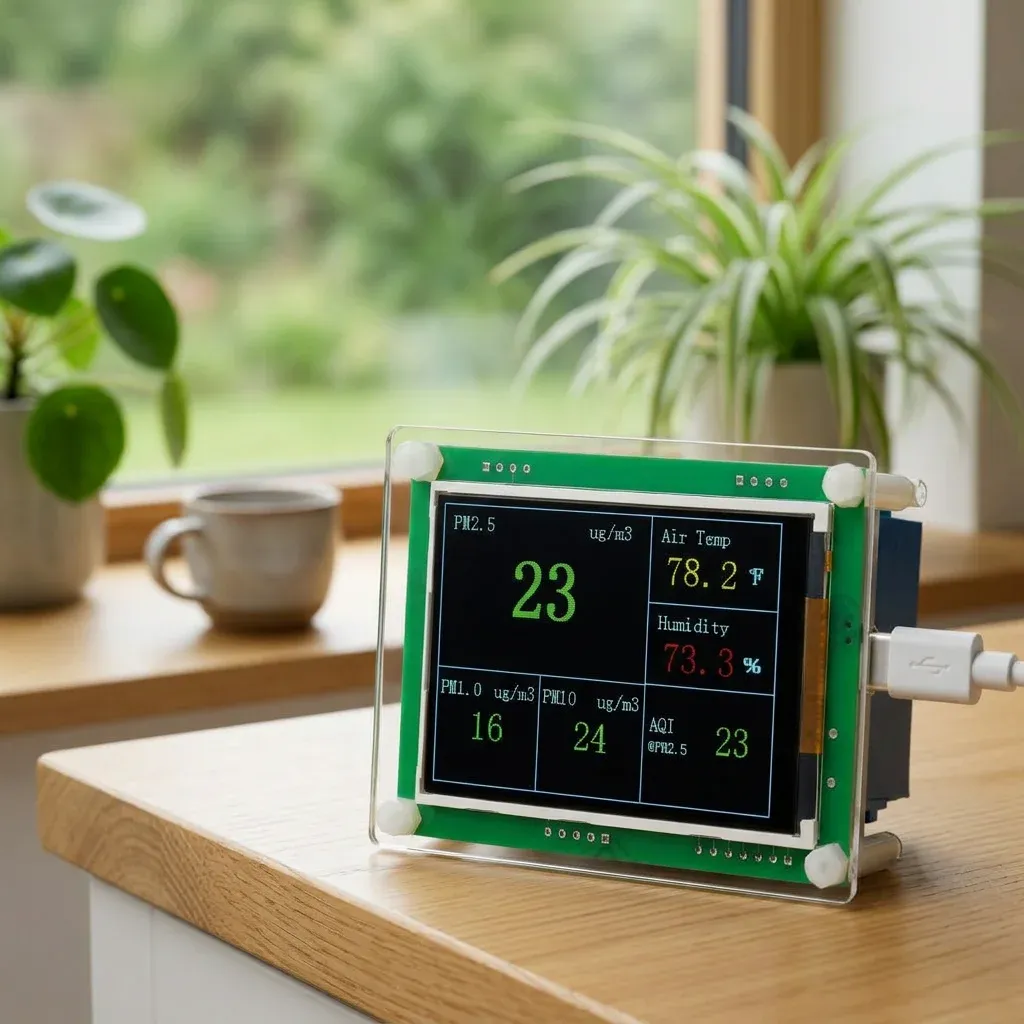
A particulate matter monitor is a device that measures tiny airborne particles such as PM1.0, PM2.5 and PM10, helping you understand whether the air inside your home, office or flat is clean or potentially harmful. In the UK, these monitors are especially useful for identifying pollution from cooking, traffic, candles, cleaning sprays and wood-burning stoves.
TL;DR: A good particulate matter monitor shows real-time PM1.0, PM2.5 and PM10 levels in µg/m³, so you can spot indoor pollution quickly and take action. Based on our testing, the most useful models for UK homes also track temperature and humidity, offer clear displays, and make it easy to see how everyday activities affect your indoor air quality.
Invisible pollutants silently move through living rooms, offices and bedrooms every day. Although the UK has made progress on outdoor air quality, indoor air pollution remains a major public health concern. Therefore, a particulate matter monitor can act as a practical diagnostic tool, allowing you to measure what you are actually breathing indoors rather than relying on guesswork.
From wood-burning stoves in rural cottages to traffic emissions drifting into London flats, microscopic particles can bypass the body's natural defences. Consequently, understanding how to measure and reduce these pollutants is the first step towards creating a healthier indoor environment. This guide explains what a particulate matter monitor does, why it matters in the UK, and which features are worth prioritising.
What are the key takeaways about a particulate matter monitor?
- A particulate matter monitor measures microscopic particles such as PM1.0, PM2.5 and PM10 suspended in the air.
- Indoor air in UK homes can be heavily affected by cooking, cleaning products, poor ventilation and domestic burning.
- Real-time readings help you identify pollution spikes and respond quickly by ventilating, changing habits or using filtration.
- Based on our testing, monitors that combine particle tracking with temperature and humidity give a more complete picture of indoor air quality.
What is a particulate matter monitor?
A particulate matter monitor is an electronic device that detects and measures tiny solid particles and liquid droplets suspended in the air. Most modern consumer devices use laser scattering technology to estimate particle concentrations, which are then displayed in micrograms per cubic metre (µg/m³).
In simple terms, it tells you how much particle pollution is present indoors at any given moment. As a result, you can see when air quality worsens during activities such as frying food, vacuuming or lighting candles.
To understand these readings properly, it helps to know how particulate matter is grouped. Particle size matters because it affects how deeply pollutants can travel into the respiratory system.
What do PM1.0, PM2.5 and PM10 mean?
- PM10: Particles 10 micrometres and smaller, including dust, pollen and mould spores.
- PM2.5: Fine particles 2.5 micrometres and smaller, often produced by vehicle exhausts, wood smoke and cooking fumes.
- PM1.0: Even smaller particles that can penetrate deeper into the lungs and are often associated with combustion and smoke.
For a deeper look at these particle sizes and why measuring all three can be helpful, read our guide: The Ultimate Guide to Pm1 Pm2.5 Pm10 Detector in the UK.
Why is a particulate matter monitor important in UK homes?
Many people assume pollution is mainly an outdoor problem. However, that is often not the case. In the UK, people spend most of their time indoors, so monitoring indoor air can be just as important as checking outdoor conditions.
According to UK health and environmental guidance, fine particulate matter is linked to respiratory and cardiovascular health risks. Therefore, understanding indoor PM levels can help households reduce exposure more effectively.
What causes high particulate matter indoors?
Many everyday household activities create particulate pollution. For example, frying food, burning candles, using aerosol sprays and vacuuming can all raise indoor PM levels. In colder months, wood-burning stoves and fireplaces can also contribute significantly.
According to DEFRA, domestic burning is a major source of fine particulate matter in the UK. Likewise, homes near busy roads may experience particle pollution entering through doors, vents and windows, especially during peak traffic hours.
"Exposure to particulate matter, even at low levels, has been robustly linked to respiratory and cardiovascular morbidity. Monitoring indoor environments empowers individuals to reduce their exposure proactively."
With a particulate matter monitor, you can see these spikes as they happen. Then, instead of guessing, you can take practical steps such as opening a window, improving extraction or changing products. If you want a broader home-focused device, see our Aqi Monitor For Home Explained: A UK Buyer's Guide.
What should you look for in a particulate matter monitor?
Not all monitors offer the same level of usefulness. While basic models may only show one pollutant reading, stronger options provide more context and make the data easier to act on.
Should a particulate matter monitor measure PM1.0, PM2.5 and PM10?
Yes, ideally it should. A monitor that tracks PM1.0, PM2.5 and PM10 gives a fuller picture of indoor particle pollution. For instance, larger dust particles and very fine smoke particles behave differently, so measuring multiple size ranges helps you understand the source more clearly.
Does temperature and humidity matter on a particulate matter monitor?
Yes, because air quality is influenced by more than particle counts alone. High humidity can support mould growth, while dry air may worsen irritation for some people. Based on our testing, devices that combine particulate readings with temperature and humidity are far more useful for day-to-day indoor air management.
How easy should a particulate matter monitor be to read?
Very easy. Clear displays, colour-coded indicators and simple air quality summaries help you interpret readings quickly. As a result, you do not need to decode raw numbers every time pollution rises.
Is portability important in a particulate matter monitor?
Often, yes. Air quality can vary a great deal between rooms. The kitchen may spike during cooking, while a bedroom may suffer from stale air overnight. Therefore, a compact monitor can be moved around the home to identify local problem areas. If you work from home, you may also want to read our Desktop Air Pollution Monitor Explained: A UK Buyer's Guide.
How do you use a particulate matter monitor effectively?
Buying the monitor is only the first step. To get reliable readings, place it at breathing height in the room where you spend the most time, such as a living room, bedroom or home office. However, avoid placing it directly beside an open window, cooker hood, purifier outlet or fan, as that can distort readings.
Next, establish a baseline over several days. Once you know what your usual PM levels look like, it becomes much easier to spot unusual spikes and identify likely causes.
Where should you place a particulate matter monitor?
For the best results, place it in a representative part of the room rather than right next to a pollution source. For example, on a side table, desk or shelf at seated head height often works well.
What can a particulate matter monitor tell you about daily habits?
It can show exactly how daily routines affect indoor air. You may notice PM2.5 rising while cooking, PM10 increasing during cleaning, or overnight readings changing with bedroom ventilation. Consequently, you can make targeted adjustments, such as using lids while cooking, opening windows briefly after cleaning, or upgrading extraction.
How accurate is a particulate matter monitor for home use?
Home particulate matter monitors are generally best used for spotting patterns, comparing rooms and detecting spikes rather than replacing laboratory-grade instruments. That said, quality monitors can still provide extremely useful real-time guidance for households.
Based on our testing, the most valuable consumer monitors are consistent, responsive and easy to interpret. In other words, even if absolute readings vary slightly from specialist equipment, trend accuracy is what helps most people improve indoor air quality in practice.
What is the best particulate matter monitor for a UK buyer?
The best particulate matter monitor for a UK buyer is one that matches your environment and goals. If you want to track cooking fumes, traffic pollution or smoke indoors, prioritise PM1.0, PM2.5 and PM10 readings. If you also want broader comfort insights, choose a device with temperature and humidity monitoring.
Airmeter focuses on practical indoor air monitoring for real homes and workplaces, with clear displays and useful real-time data designed to support everyday decisions. Therefore, the right device is not just the one with the longest specification list, but the one you will actually use to improve your indoor environment.
Frequently asked questions about particulate matter monitors
What does a particulate matter monitor measure?
It measures airborne particles such as PM1.0, PM2.5 and PM10, usually in µg/m³. Some models also include temperature, humidity and AQI-style summaries.
Are particulate matter monitors worth it in the UK?
Yes, especially in homes affected by cooking fumes, traffic pollution, poor ventilation or wood burning. They provide real-time information that can help you reduce exposure.
Can a particulate matter monitor detect cooking smoke?
Yes. Cooking, especially frying or searing, can cause sharp PM2.5 and PM1.0 spikes, which most good monitors will show clearly.
What is a safe PM2.5 level indoors in the UK?
Guidance can vary by source and averaging period, but lower is generally better. According to UK and international health guidance, persistent elevated PM2.5 should be taken seriously, particularly for children, older adults and people with asthma or heart and lung conditions.
Ready to try Airmeter?
Shop Now — £61.51